投稿

花巻の土人形 Hanamaki Clay Doll
イメージ
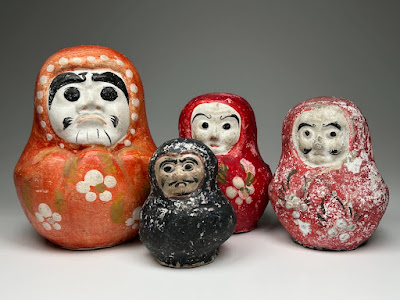
これから紹介する土人形はいずれも岩手県花巻市で江戸後期から昭和前期にかけてつくられた「花巻人形」に該当すると考えられる。 The following clay dolls were probably made in Hanamaki, Iwate prefecture, Japan, in the 19th to early 20th centuries. だるま Daruma Heights: 12.0 cm (biggest one) to 6.9 cm (black one) 花巻のだるまは魅力的なものが多く、みつけるとつい手に入れたくなってしまう。なにか困ったような神妙な顔とファンシーな花柄文様とのアンバランスさがたまらない。赤いだるま3体にはいずれも背面に「◯」の窯印がみられる。手前の黒いだるまは類例を他に見たことがないので、珍品の部類にはいるだろう。 Hanamaki  daruma dolls are so attractive that I can't ignore it. The contrast between a face like a philosopher and a showy flower pattern makes it distinct. There are circle stamps on the back of red darumas . The black one is rare in Hanamaki. 赤いダルマは背面は赤くない。黒いダルマは全面黒い。だるま人形は全国各地でつくられているが、花巻だるまはわたしの中では魅力度ランキング第1位だ。 牛乗り童子 A Boy on a Cow Height: 9.4 cm / Width: 10.0 cm 電気もクルマもない時代、牛は農耕や物資の運搬のために重用された。この人形は岩手の人々と牛との深い結びつきを示す実例と言えよう。着物の赤色は焦げついたような質感があり、あまり他では見かけないようにおもう。この手の小さい人形は地元ではまめっこ人形と呼ばれていて、かわいい魅力的なものが多く見受けられる。 In the age of no electricity and no automobile...

相良人形の鯉担ぎ Boy and Carp, Sagara Doll

イメージ
Width: 11.5 cm / Height: 10.5 cm 大きな鯉を肩に担ぐ少年をかたどったこの土人形は、お顔立ちや衣装の柄などからして江戸期の相良人形(現在の山形県米沢市で江戸後期に創始された土人形)とみてよいだろう。これはあきらかに節句人形のひとつで、子ども、とくに男の子が力強く育つように、との願いが込められている。かつて山形あたりでは3月の節句にこういった土人形を何個も並べて飾りつける風習があった。現代の「ひなまつり」は女の子のものと相場が決まっていて、飾る人形の種類も内裏雛や五人囃子など形骸化しているが、このころはこうした鯉担ぎの他、天神さまや金太郎などの男の子向けの人形も含め、さまざまな人形を一緒に飾っていたようである。 A boy is shouldering a big carp. This would be a piece of the old Sagara that began in the early 19th-century Yonezawa, Yamagata prefecture, Japan. Carp stood for a powerful man who succeeded in his business, as legend said a carp became a dragon after swimming against a waterfall. The local people displayed various clay dolls on the occasion of the doll festival (the third of March). The doll festival is generally regarded as a day for girls at present, but people in Yamagata displayed dolls not only for girls but for boys such as carp, Tenjin, and Kintaro dolls, which were symbols of powerful and clever boys. 耳のところに黒い繊維状の物質が埋め込まれて髪の毛を表現している。緋鯉のつ...

村山地方の土人形 Clay Dolls in Murayama District

イメージ
かつて東北地方には土人形の産地がたくさんあった。江戸期の堤人形、花巻人形、相良人形など、美術的評価がある程度定まっているものは別として、明治以降のものは安価で程度の低い土俗の玩具とみなされる傾向にあり、いまでは顧みる人もすくない。上の写真はそんな「歴史に埋もれた」土人形の典型例というべきものだ。堤人形と似た点があるので愛好家や古物業者は「堤の脇窯」もしくは「堤系」の人形と呼んでいる。幕末から明治にかけて山形県の村山地方で製造されたと考えられるものの、どこのだれがつくったのかよくわかっていない。 There were once many clay doll manufacturers in the Tohoku Region, Japan. Apart from old Tsutsumi (Sendai), Hanamaki, and Sagara (Yonezawa) dolls in the 18th or early 19th century, later ones tended to be thought as cheap, low-quality, worthless toys. That is why the clay dolls in the above picture are of uncertain origin, though they were likely produced in the Murayama district, Yamagata, in the mid or late 19th century. As there is a similarity to the old Tsutsumi, antique collectors and dealers often call it a "Tsutsumi-related" doll. 大黒さま Daikoku #1(左):大黒。人形の幅は 12.5 cm、高さは 10.0 cm。 これは土赤五郎吉なる工人がいまの東根市猪野沢(いのさわ)地区で明治期に製作した、と古人形愛好家が推定している人形(「郷土人形図譜・堤系人形」のBグループで猪野沢人形と呼んでいるもの)と似た点がある。全体を彩る赤色塗料がたいへん鮮やかでインパクトが...

兎丸文 のぞき猪口 Rabbit and Circle Pattern Nozoki-type Cup

イメージ
Width: 51 mm / Height: 44 mm 半筒に近い、ちょっとめずらしい形ののぞき猪口。丸文が5つあって、その中には寿の字、樹下人物図、山水楼閣図、菖蒲、そしてなんとも愛らしい波兎がそれぞれ描かれる。絵付けはとてもていねいで、19世紀はじめ頃の上手の古伊万里と考えられる。 An old Imari nozoki -type cup that is relatively rare in shape. Drawn inside five circles are a Chinese character meaning congratulations, two persons under trees, a castle in a landscape, irises, and a lovely rabbit running above a wave. I guess it was a high-quality Imari ware in the beginning of the 19th century. 波に兎の意匠は、白波が立つ水面に月が映っているさまを、兎が走っているように見えるとたとえたもので、謡曲「竹生島」の一節から江戸期に流行した、と言われている。他の文様も情景ゆたかに描かれている。 A rabit running above a wave shows a wavy water surface reflecting the Moon, in which Japanese believed a rabbit lived. The rabbit and wave pattern was popular in the Edo period (from 17th to mid 19th centuries).

菊花文 のぞき猪口 Chrysanthemum Nozoki-type Cup

イメージ
Height: 61 mm / Top width: 54 mm 上に向かってじゃっかん末広がりな形をしたのぞき猪口。上下互い違いに8個描かれる文様は菊の花とされる(たとえば中島由美 編「古伊万里 蕎麦猪口・酒器 1000」17ページ、講談社、2001年;「小さな蕾」2020年10月号、24ページ、創樹社美術出版、など)。古伊万里界隈では皇室の紋章のような抽象化された菊文のほうが出現頻度が高いとおもうが、これは重力によって花びらが垂れ下がった具象的な菊文で、レア度はやや高いだろう。一般に古伊万里は器全面を文様で埋め尽くす傾向にあるが、これは白磁の余白をのこしたデザインだ。ちょっとしたユーモアが感じられる。 A nozoki -type small Imari cup with a top rim slightly wider than the bottom. Eight marks drawn in an alternate way mean chrysanthemum flower. I think this type of chrysanthemum hanging down under gravity is rarer in old Imari wares than more abstract symbol like the Imperial seal of Japan. The design leaving white margin is also comparatively rarer in old Imari wares. I think it has a bit sense of humor. のぞき猪口2種。 これとほとんど同じ形状をした猪口(以前 こちら で紹介した)と並べてみたのが上の写真である。どちらも文様の描き方や配置がシャレている。渦福銘や縁べりの四方襷文の描き方もおなじで、同一工房でほぼ同じ時期につくられたのではないかと推測する。 The above photo compares two nozoki -type cups, one of which has been shown in this blog. There are similarities in the shape, th...

仙北地方の小さなかめ Small Pots from Senboku Region

イメージ
19世紀に秋田県仙北地方の白岩か楢岡あたりで焼かれたと考えられる小さなかめ(甕)を3つほど手に入れた。 I obtained three small earthenware pots that were probably from the 19th-century Shiraiwa or Naraoka potteries in the Senboku Region, Akita prefecture, Japan. 1個目 Height: 10.8 cm / Width: 10.8 cm 全体が丸っこくて、口がちょっと外向きに立ち上がる、独特の形をしたかめ。落ち着いた光沢の鉄釉(泥釉)の上には青みを帯びた白色のなまこ釉がかかっていて、この色合いも独特だ。高台の細工もていねいで、大きさの割には手間がかかっているとおもう。たぶん幕末から明治初期の白岩焼だとおもうが、もしそうだとすると、これはもう単なる雑器の一言では片付けられない、古白岩の逸品と言ってもいいのではなかろうか。 This round-shaped pot has a distinct top rim that stands a bit outward. The glaze's color over a brown coating is subtly bluish white, which would be especially outstanding. The work on the bottom part shows a delicate workmanship. This was merely a small daily-use earthenware, but I presume it would be one of the masterpieces of old Shiraiwa ware, if my estimation of this pot's origin is correct. 2個目 Height: 8.5 cm / Width: 9.1 cm 1個目よりひとまわり小さい豆かめ。この手のかめとしては最小サイズだろう。鉄釉はテカテカしていて、口べりのなまこ釉はじゃっかん緑がかったクリーム色にみえる...